
In the current digital age, a website is no longer just an optional communication platform for institutions. For schools, organizations, and learners, it has become an important tool for sharing information, showcasing achievements, connecting with communities, and creating opportunities for innovation.
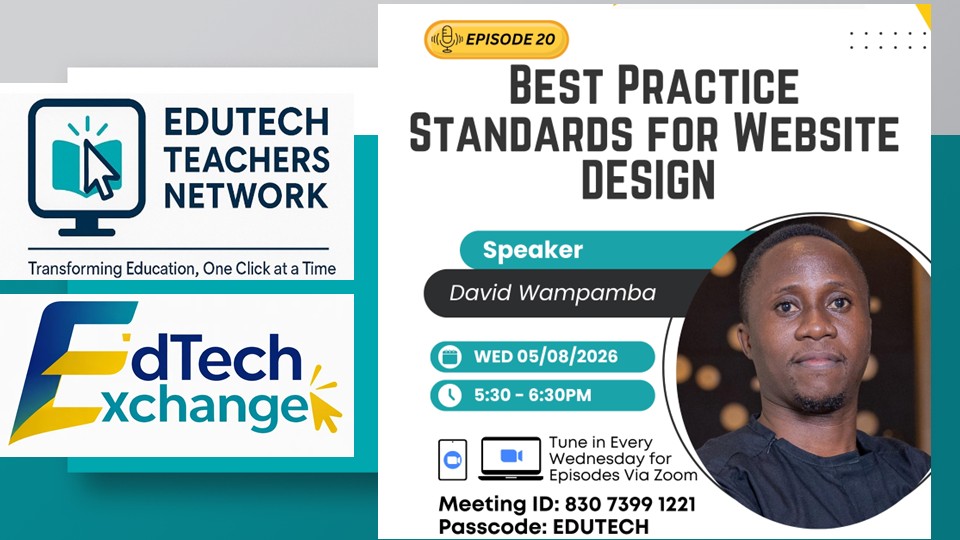
As part of the EdTech Exchange weekly learning sessions, Episode 20 focused on “Best Practice Standards for Website Design”, bringing together educators, ICT coordinators, school leaders, and innovators to explore how effective website design can support both institutional digital presence and learner project work.
The session was facilitated by David Wampamba, a web developer, software development coach, and digital innovation mentor with experience in website development and technology communities. He shared practical insights on what makes websites effective, user-friendly, and impactful.
Why Website Design Matters in Education
Opening the session, the importance of websites in today’s education ecosystem was highlighted. Schools are increasingly expected to establish an online presence where they can communicate with parents, learners, partners, and the wider community.
Beyond institutional communication, websites are also becoming common innovation projects within competence-based learning, providing learners with opportunities to apply creativity, collaboration, problem-solving, and digital skills to develop practical solutions.
A well-designed school website can therefore serve two purposes:
- Strengthening the school’s digital identity and communication
- Providing a platform for learners to demonstrate creativity through web-based projects
Understanding Good Website Design
During the session, participants explored key characteristics of professionally designed websites. David emphasized that a good website should be:
1. Usable
A website should be easy for visitors to understand and navigate. Users should quickly find the information they need without confusion.
2. Accessible
Websites should be designed with different users in mind, ensuring that information can be accessed by as many people as possible.
3. Fast
Website speed affects user experience. Slow websites often discourage visitors from engaging with the content.
4. Consistent
A good website maintains consistency in its design, layout, navigation, and branding, creating a professional experience for users.
From Website Creation to Meaningful Digital Projects
One of the key discussions during the session was the role of websites in learner innovation projects.
With the competence-based curriculum emphasizing practical skills and project work, learners can use website development to:
- Showcase school projects and innovations
- Create digital portfolios
- Develop community-focused information platforms
- Publish research and creative work
- Build solutions that address real-world challenges
However, meaningful web projects require more than simply creating pages. Learners need guidance on planning, understanding users, organizing information, designing interfaces, and maintaining digital content.
Common Considerations for School Websites
The session highlighted several important areas schools should consider when developing or improving their websites:
Clear Purpose
Before designing a website, schools should define what the website should achieve. Is it mainly for communication, showcasing projects, providing resources, or supporting online services?
Good User Experience
Visitors should easily access important information such as:
- School background
- Academic programs
- Announcements
- Events
- Contact information
- Learner achievements
Mobile-Friendly Design
Since many users access websites through smartphones, responsive design is essential. Websites should adapt well to different screen sizes.
Quality Content
A good website requires regular updates, accurate information, and engaging content.
Empowering Educators and Learners Through Web Development
The session encouraged educators to view website development not only as a technical skill but also as a tool for creativity and innovation.
ICT teachers, club patrons, and school leaders have an important role in creating environments where learners can experiment, collaborate, and develop digital solutions.
Through ICT clubs and project-based learning, learners can move from being consumers of technology to creators of technology.
Watch the Full Session Recording
The complete recording of EdTech Exchange Episode 20: Best Practice Standards for Website Design is available below:
Conclusion
As schools continue to embrace digital transformation, having an online presence is becoming increasingly important. However, an effective website is not defined only by appearance; it is defined by how well it serves users, communicates information, and creates value.
For educators and learners, website development provides an opportunity to combine creativity, technology, and problem-solving to produce meaningful digital solutions.
Through initiatives like EdTech Exchange, the EduTech Teachers Network continues to support educators in exploring practical ways of integrating ICT into teaching, learning, innovation, and school transformation.
Let us continue exchanging ideas, experiences, and resources for integrating ICT — one click at a time.
#EdTechExchange #ICTinEducation #DigitalLearning #WebDesign #CompetenceBasedLearning #InnovationInEducation #IClickAtaTime
Leave a Reply