
30 May 2026 | Eden Cradle Care Pre-School, Wairaka – Jinja District
Early childhood education is changing rapidly. As digital technologies become increasingly part of everyday life, teachers are finding new ways to make learning more interactive, creative and engaging for young children.
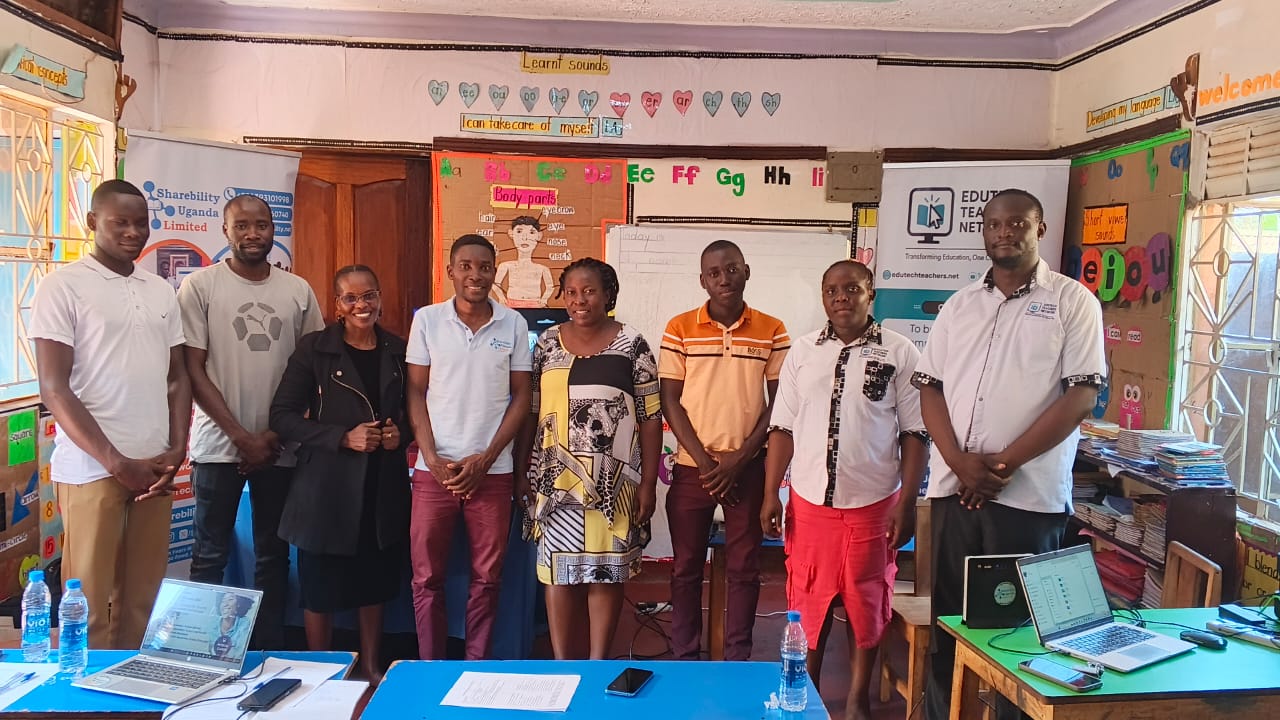
It was against this background that the EduTech Teachers Network (ETN) successfully hosted a specialized One-Day Education Technology Capacity Building Workshop for Early Childhood Educators on Saturday, 30th May 2026 at Eden Cradle Care Pre-School, Wairaka, Jinja District.
The workshop brought together nursery, kindergarten and Early Childhood Development (ECD) educators, as well as school leaders and administrators, for a practical day focused on using technology to improve teaching, learning and school administration.
The workshop was specifically designed around the needs of early childhood educators, while also providing useful digital skills and resources applicable to teachers across other levels of education. The official programme included sessions on EdTech access planning, play-based digital learning, Canva, AI and e-learning tools, educational video creation and Excel-based reporting.
Putting Collaboration Tools into the Hands of Teachers
One of the key sessions was facilitated by Mr. Mukalele Rogers, who introduced participants to digital collaboration tools and demonstrated how teachers can use technology to work and learn together.


The session exposed educators to tools within the Google ecosystem, including Google Drive, Google Docs and Google Sheets. These tools were presented as practical solutions for creating, storing, sharing and collaboratively working on documents and other educational resources.
For nursery and ECD educators, such tools can support collaboration between teachers, sharing of lesson resources, preparation of teaching materials and coordination of school activities.
Mr. Mukalele also took participants through online studying and virtual learning tools, including Zoom and Google Meet. Educators explored how these platforms can support online meetings, teacher learning, professional development and remote interaction.
This session reflected ETN’s commitment to continuous professional development and to helping educators become confident users of digital technologies.
Turning a Smartphone into a Teaching Studio
For many early childhood educators, the smartphone is one of the most accessible pieces of technology available to them.
Mr. Julius NsiIro built on this reality by taking participants through a practical session on educational video content creation.


Teachers were shown how to use a mobile phone to record educational videos, providing them with a simple starting point for creating digital learning resources.
The training then moved to video editing, where participants were introduced to CapCut as a tool for transforming raw recordings into more engaging educational content. The session also covered how teachers can upload their finished videos to YouTube, opening opportunities for educators to create and share learning resources beyond the physical classroom.
For early childhood education, this skill is particularly valuable because songs, stories, demonstrations, music and movement activities can be presented through short and engaging videos.
The official workshop programme also identified educational video creation as a practical area of training, with emphasis on using smartphones to record and edit instructional content for activities such as music and movement.
The message was simple: teachers do not have to wait for expensive equipment to become digital content creators. A smartphone, the right skills and creativity can be enough to begin.
Exploring Artificial Intelligence for Early Childhood Educators
Artificial Intelligence was another important area of the workshop.
Mrs. Norah guided participants on the use of Artificial Intelligence in education, helping educators understand how AI tools can support their daily work.
The session connected AI with practical teacher responsibilities such as lesson preparation, content generation and improving teacher productivity.
This was particularly relevant to the workshop because the official programme included a dedicated session on AI and e-learning tools, designed to demonstrate AI-powered tools for lesson preparation and educational content generation.
For early childhood educators, the value of AI is not simply in using the newest technology. It is in understanding how these tools can help teachers prepare better resources while still ensuring that learning remains age-appropriate, creative, interactive and centred on the child.
Digital Learning That Starts with Play
A central theme of the workshop was the importance of making technology appropriate for young learners.
The programme included a dedicated session on Play-Based Digital Learning, exploring how technologies such as tablets and educational applications can support early childhood development and interactive learning.
This approach recognises that technology in early childhood should not replace play, interaction or the teacher. Instead, it should complement these experiences.
Digital tools can help teachers introduce pictures, sounds, stories, songs, animations and interactive activities that capture children’s attention and support different ways of learning.
For an ECD teacher, therefore, digital pedagogy is not about putting a child in front of a screen for long periods. It is about using technology thoughtfully to enrich experiences that are already meaningful to young children.
Creating Attractive Learning Resources with Canva
The workshop also placed emphasis on teacher creativity and digital content development.
Through the Canva session, educators explored how they can create visually appealing learning resources for young children, including alphabet charts, picture cards, routine charts and classroom posters.
This was particularly relevant for nursery and kindergarten teachers because young children respond strongly to visual and colourful learning materials.
Instead of relying entirely on commercially produced materials, teachers can increasingly develop their own resources based on the needs, interests and learning environment of their children.
The training therefore positioned educators as creators of digital learning resources, not merely users of resources created by others.
Making School Reporting Easier with Digital Tools
Technology was also introduced as a solution to some of the administrative responsibilities faced by teachers and school leaders.
The programme included practical training on an Excel-Based Report Card Tool, where participants learned how spreadsheets can be used to compute marks, automate grading calculations and generate report cards for nursery, primary and secondary schools.
This demonstrated another important dimension of ETN’s work: technology is not only about classroom teaching. It can also support school administration, assessment and reporting.
By reducing repetitive manual work, digital tools can allow educators to spend more time focusing on learners and other important responsibilities.
Building a Community of Digitally Empowered Educators
Beyond the individual sessions, the workshop provided an opportunity for educators to connect, exchange experiences and learn from one another.
This community aspect is central to the mission of the EduTech Teachers Network.
ETN’s vision is “Empowered educators leading digital innovation for transformative learning,” while its mission is to build a professional community of educators across nursery, primary, secondary and tertiary institutions who have the skills, knowledge and support to integrate ICT for safe, innovative and inclusive competence-based pedagogy.
The Network’s objectives include continuous professional development, digital literacy, effective and safe use of technology, development and sharing of digital content, peer mentorship and Professional Learning Communities (PLCs).
The Wairaka workshop brought these objectives to life by giving educators practical opportunities to learn, practise and share digital skills.
From Training to Transformation
The success of the Early Childhood Educators Workshop demonstrated that digital transformation in education does not always require complex technology.
Sometimes it begins with a teacher learning how to use Google Drive to collaborate with colleagues, Zoom to participate in professional learning, Canva to create a picture card, AI to generate ideas, or a smartphone and CapCut to produce a short learning video.
These seemingly simple skills can make a meaningful difference when they are applied purposefully in the classroom.
For early childhood educators, the goal is not to replace the traditional foundations of early learning. Rather, it is to combine play, creativity, interaction and technology in ways that support children’s development and make teachers more effective.
The workshop therefore represented more than a one-day training. It was part of ETN’s broader effort to build a growing community of educators who are confident, creative and prepared to lead digital innovation in their schools.
As the EduTech Teachers Network continues to expand its programmes across Uganda, the message remains clear:
Empower the teacher. Transform the classroom. Improve the learning experience.
And, in the spirit of ETN’s motto:
Transforming Education, One Click at a Time.
Join the EduTech Teachers Network and become part of a growing community of educators committed to learning, sharing and transforming education through technology.
🌐 www.edutechteachers.org
📧 info@edutechteachers.net
📞 +256 393 101 998
Leave a Reply