

Uganda’s ambition to transform education through technology has received an important reality check.
The report, From Unplugged to ICT-Ready: A Digital Readiness Assessment of Secondary Schools in Uganda, recently released by UNICEF, assessed 3,257 secondary schools—representing 78% of all secondary schools registered with the Association of Secondary School Headteachers of Uganda (ASSHU)—and paints the clearest picture yet of the country’s readiness for digital learning.
The findings reveal a system with enormous potential but significant inequalities.
While digital transformation has become a central pillar of Uganda’s education agenda, only 20% of secondary schools are classified as ICT-ready, while 41% are semi-connected and 39% remain unplugged, lacking the minimum conditions needed to support meaningful digital learning.
For educators, school leaders, policymakers, and development partners, the report offers more than statistics. It presents a roadmap for understanding where schools are today and what must happen next if no learner is to be left behind in the digital age.
Three Ugandas in One Education System
The assessment identifies three distinct categories of schools.
At one end are ICT-ready schools, where learners have access to reliable electricity, stable internet connectivity, and a relatively favourable learner-to-device ratio. These schools are already integrating technology into teaching and learning.
In the middle are semi-connected schools—the largest group—which possess some infrastructure but face frequent power interruptions, unstable internet, and limited support. These schools have the greatest potential for rapid improvement if targeted investments are made.
At the other end are unplugged schools. Many of these schools have little or no internet connectivity, limited electricity, and severe shortages of digital devices, making meaningful digital learning virtually impossible. These schools are disproportionately located in rural communities, particularly in Northern and Eastern Uganda.
The findings remind us that digital transformation is not occurring evenly across the country. A learner in Kampala may have regular access to digital resources, while another learner in a rural district may never have the opportunity to interact with educational technology during their entire secondary education journey.
Infrastructure Matters—But It Is Not Enough
One of the report’s most important messages is that digital learning is about far more than devices.
Although 98% of schools report access to electricity, only half enjoy reliable power for more than 16 hours per day. Nearly 38% of schools have no internet access at all, while many connected schools experience daily disruptions. In some districts, a single computer serves more than 200 learners, with extreme cases reaching over 300 learners per device.
Yet the report also cautions against viewing infrastructure as the sole solution.
International evidence cited in the study shows that technology only improves learning when it is accompanied by quality content, teacher support, pedagogical guidance, and strong leadership. Simply supplying computers without addressing these factors risks increasing teacher workload rather than improving learning outcomes.
Leadership: Uganda’s Hidden Digital Asset
Perhaps the most encouraging finding in the report is that school leadership commitment remains consistently strong across all regions and readiness levels.
More than 90% of school leaders recognize the importance of digital learning for developing computer skills, information access, and responsible technology use. Importantly, this commitment remains high even in schools facing the greatest infrastructure challenges.
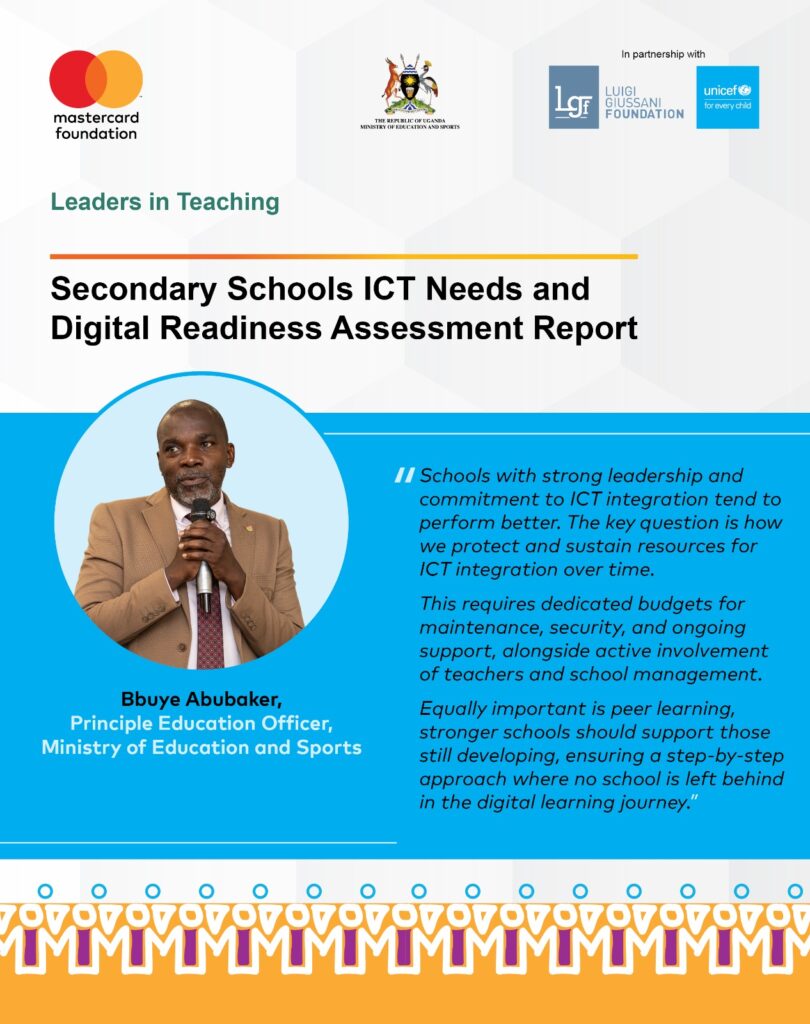
As Bbuye Abubaker, Principal Education Officer at the Ministry of Education and Sports, noted:
“Schools with strong leadership and commitment to ICT integration tend to perform better. The key question is how we protect and sustain resources for ICT integration over time.”
His remarks highlight a critical reality: digital transformation is not merely a technical project—it is a leadership project.
Schools that successfully integrate technology are often led by administrators who prioritize innovation, mobilize resources, support teacher development, and create a culture of continuous learning.
Technology Should Support Teachers, Not Replace Them
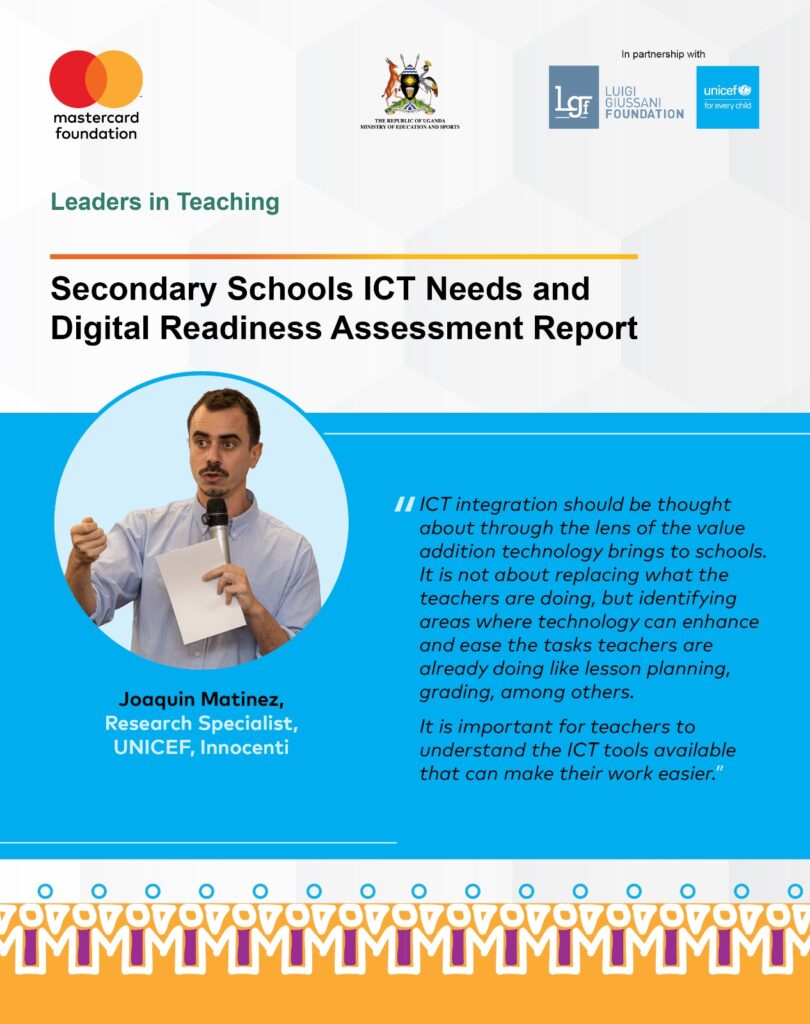
Another powerful reflection came from Joaquin Matinez, Research Specialist at UNICEF Innocenti, who emphasized that digital transformation should focus on supporting teachers rather than replacing them.
“ICT integration should be thought about through the lens of the value addition technology brings to schools. It is not about replacing what teachers are doing, but identifying areas where technology can enhance and ease the tasks teachers are already doing like lesson planning, grading, among others.”
For teachers, this message is particularly important.
Technology should simplify planning, improve assessment, support learner engagement, expand access to resources, and create opportunities for collaboration. When introduced thoughtfully, digital tools become teaching assistants rather than additional burdens.
The Missing Piece: Teacher Capacity and Digital Pedagogy
The report identifies leadership, infrastructure, and partnerships as key strengths. However, the next stage of Uganda’s digital journey must focus on strengthening teacher capacity.
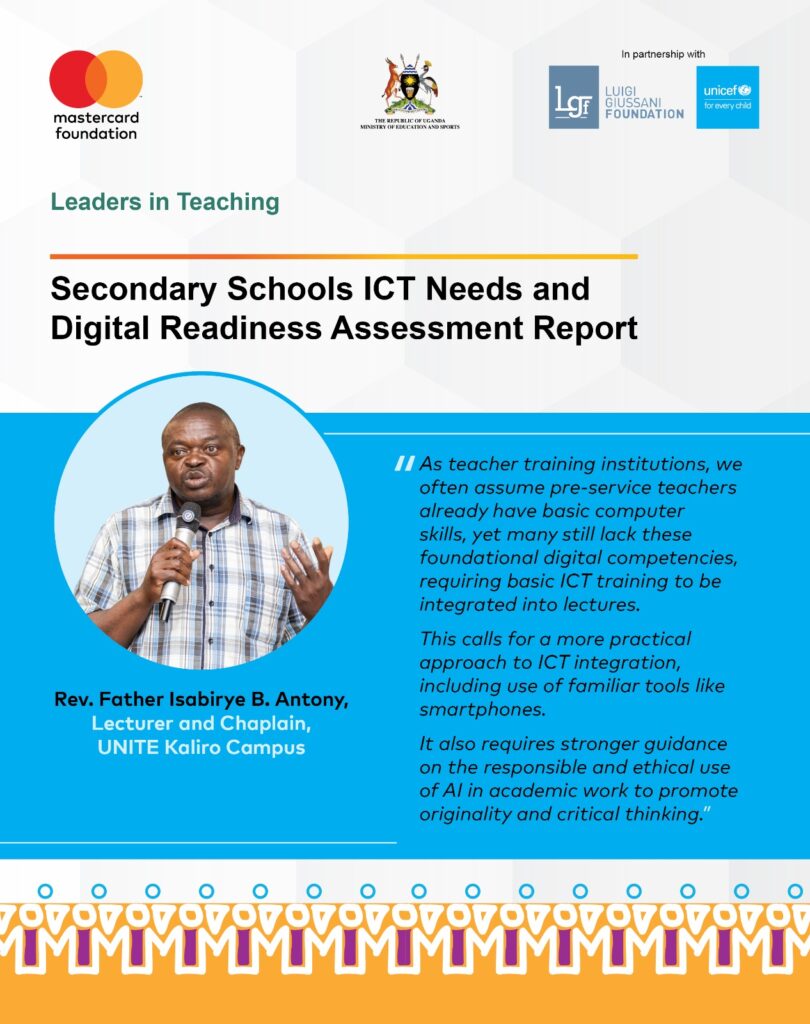
As Rev. Fr. Isabirye B. Antony of UNITE Kaliro Campus observed:
“Many pre-service teachers still lack foundational digital competencies, requiring basic ICT training to be integrated into lectures.”
His observation reflects a challenge ETN encounters frequently through teacher professional development programs. Access to technology is growing faster than educators’ confidence in using it effectively.
The future of digital learning therefore depends on more than infrastructure investment. It requires sustained investment in:
- Digital pedagogy
- AI literacy and responsible use of emerging technologies
- Digital content creation
- Online safety and digital citizenship
- Continuous professional development
- Peer learning communities
Technology becomes transformative only when teachers are empowered to use it meaningfully.
Content Remains a Major Challenge
While internet access receives considerable attention, the report reveals another significant challenge.
Among connected schools, 76% reported that available digital content remains insufficient. Schools also expressed concerns about content quality, curriculum alignment, local relevance, language adaptation, and accessibility for learners with disabilities.
This finding presents a major opportunity for teachers.
Educators are not only consumers of digital content; they can also become creators. Through collaborative networks such as ETN, teachers can develop and share locally relevant lesson materials, videos, assessments, simulations, and open educational resources aligned to Uganda’s curriculum.
Key Voices Shaping the Way Forward
The report’s release brought together voices from government, development partners, school leadership, and higher education institutions, all emphasizing different dimensions of the digital transformation journey.
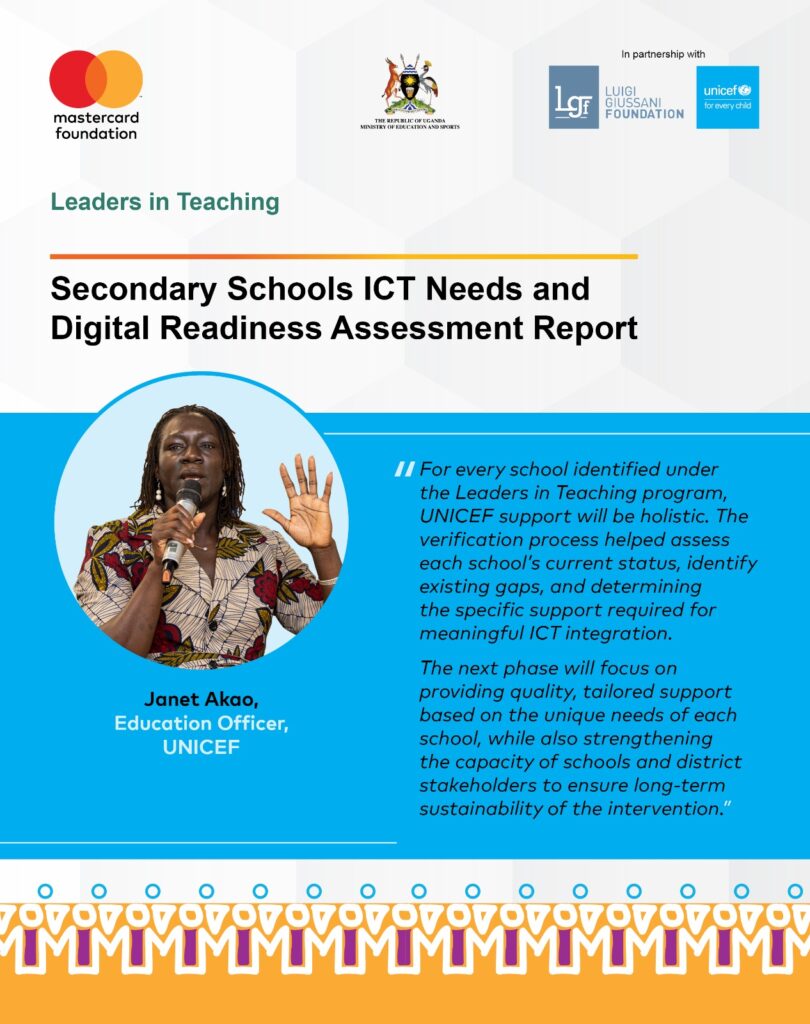
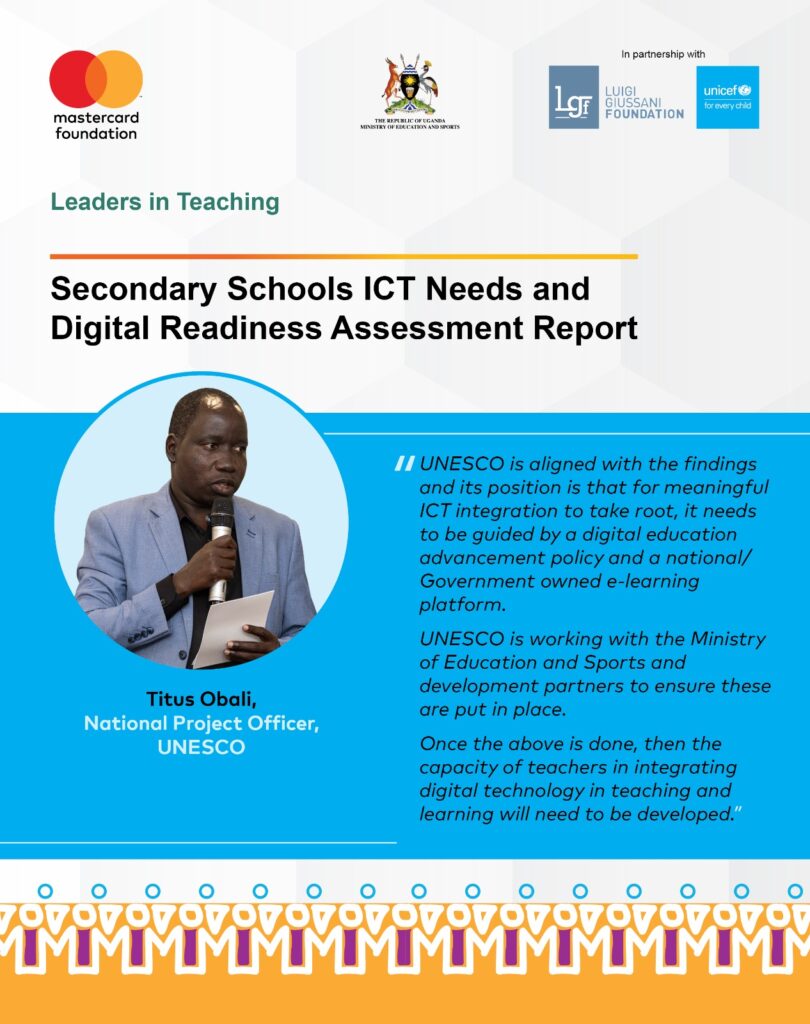
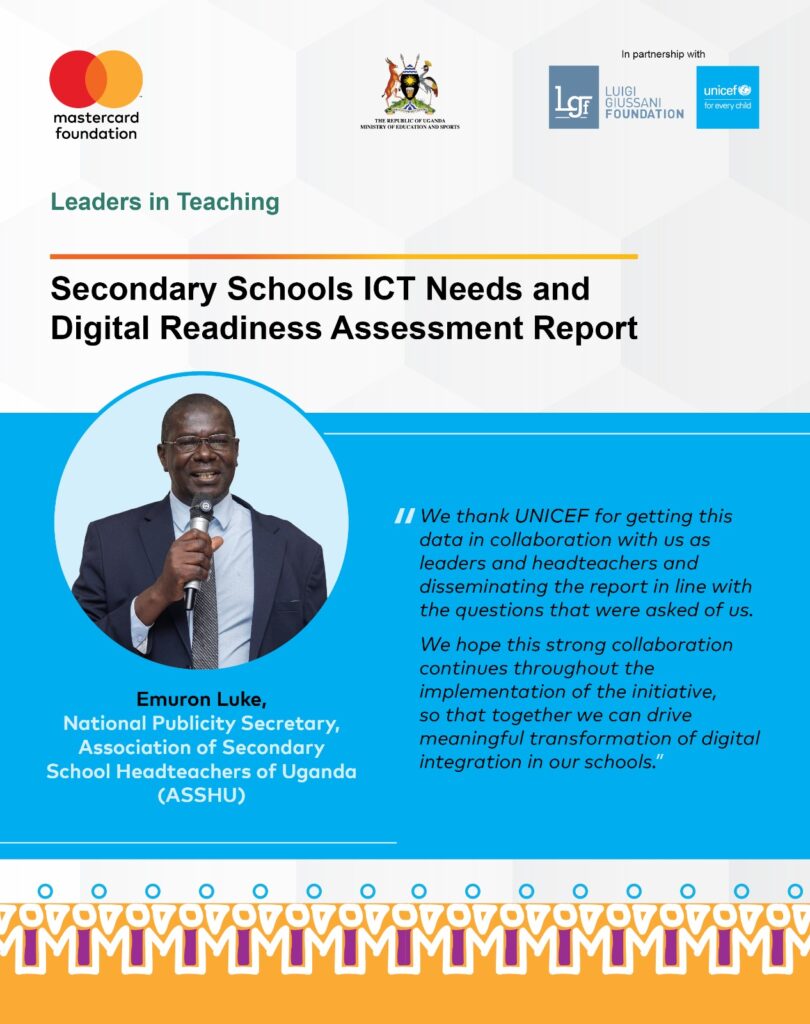
Collectively, these voices point toward a common conclusion: Uganda’s digital future will depend on coordinated action rather than isolated interventions.
ETN Reflection: From Readiness to Transformation
For the EduTech Teachers Network (ETN), the message is clear:
Digital transformation is not about technology alone. It is about empowering teachers, strengthening schools, and ensuring every learner—regardless of location—has the opportunity to participate in the future of learning.
The Digital Readiness Assessment confirms that Uganda is not starting from scratch. Strong leadership, growing platform adoption, active partnerships, and increasing policy attention provide a solid foundation for progress.
However, the findings also reveal a digital divide that cannot be ignored.
If Uganda is to achieve equitable digital learning, investments must focus not only on connectivity and devices but also on teacher capacity, digital content, leadership development, sustainability, and support for the schools furthest behind.
As educators, we must move beyond asking whether schools have technology and begin asking whether technology is improving learning.
That is the journey from being merely connected to becoming truly transformed.
Leave a Reply